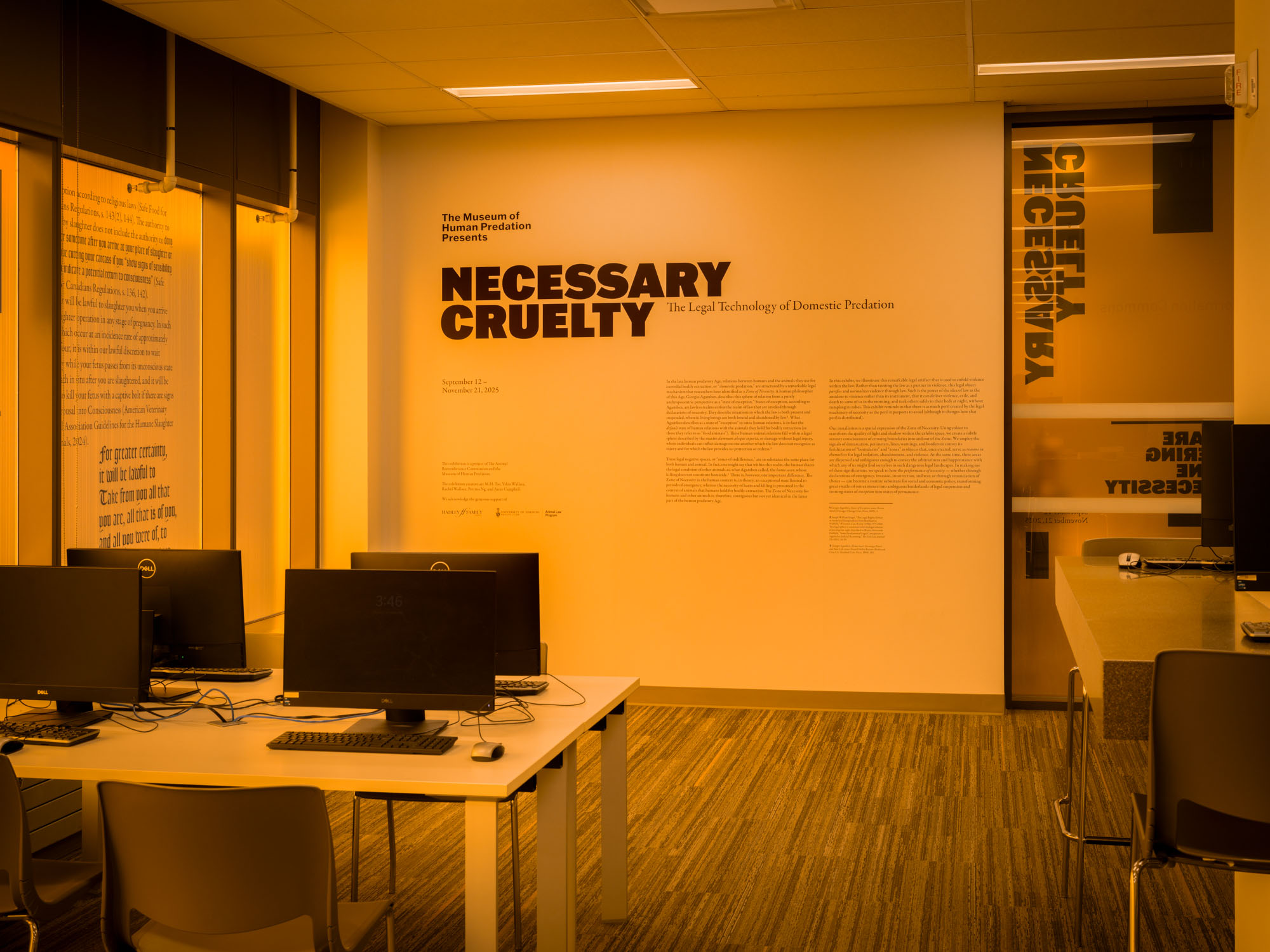
Necessary Cruelty: The Legal Technology of Domestic Predation
September 12 - November 21, 2025
Bora Laskin Law Library, University of Toronto, Toronto, Ontario, Canada
The Museum is thrilled to present a new exhibition that materializes and examines The Zone of Necessity, a legal artifact used in the human predatory Age to create realms of lawlessness within the law.
Exhibition Statement
In the late human predatory Age, relations between humans and the animals they use for custodial bodily extraction, or “domestic predation,” are structured by a remarkable legal mechanism that researchers have identified as a Zone of Necessity. A human philosopher of this Age, Giorgio Agamben, describes this sphere of relation from a purely anthropocentric perspective as a “state of exception.” States of exception, according to Agamben, are lawless realms within the realm of law that are invoked through declarations of necessity. They describe situations in which the law is both present and suspended, wherein living beings are both bound and abandoned by law.[1] What Agamben describes as a state of “exception” in intra-human relations, is in fact the default state of human relations with the animals they hold for bodily extraction (or those they refer to as “food animals”). These human-animal relations fall within a legal sphere described by the maxim damnum absque injuria, or damage without legal injury, where individuals can inflict damage on one another which the law does not recognize as injury and for which the law provides no protection or redress.[2]
These legal negative spaces, or “zones of indifference,” are in substance the same place for both human and animal. In fact, one might say that within this realm, the human shares the legal condition of other animals as, what Agamben called, the homo sacer, whose killing does not constitute homicide.[3] There is, however, one important difference. The Zone of Necessity in the human context is, in theory, an exceptional state limited to periods of emergency, whereas the necessity of harm and killing is presumed in the context of animals that humans hold for bodily extraction. The Zone of Necessity for humans and other animals is, therefore, contiguous but not yet identical in the latter part of the human predatory Age.
In this exhibit, we illuminate this remarkable legal artifact that is used to enfold violence within the law. Rather than tainting the law as a partner in violence, this legal object purifies and normalizes violence through law. Such is the power of the idea of law as the antidote to violence rather than its instrument, that it can deliver violence, exile, and death to some of us in the morning, and tuck others safely in their beds at night, without rumpling its robes. This exhibit reminds us that there is as much peril created by the legal machinery of necessity as the peril it purports to avoid (although it changes how that peril is distributed).
Our installation is a spatial expression of the Zone of Necessity. Using colour to transform the quality of light and shadow within the exhibit space, we create a subtle sensory consciousness of crossing boundaries into and out of the Zone. We employ the signals of demarcation, perimeters, lines, warnings, and borders to convey its fetishization of “boundaries” and “zones” as objects that, once erected, serve as reasons in themselves for legal isolation, abandonment, and violence. At the same time, these areas are dispersed and ambiguous enough to convey the arbitrariness and happenstance with which any of us might find ourselves in such dangerous legal landscapes. In making use of these significations, we speak to how the performance of necessity — whether through declarations of emergency, invasion, insurrection, and war, or through renunciation of choice— can become a routine substitute for social and economic policy, transforming great swaths of our existence into ambiguous borderlands of legal suspension and turning states of exception into states of permanence.
[1] Giorgio Agamben, States of Exception, trans. Keven Attell (Chicago: Chicago Univ. Press, 2005), 1.
[2] Joseph William Singer, “The Legal Rights Debate in Analytical Jurisprudence from Bentham to Hohfeld,” Wisconsin Law Review (1982): 975-1060. This legal sphere is consistent with the legal relation of privilege/no-right, described in Wesley Newcomb Hohfeld, “Some Fundamental Legal Conceptions as Applied in Judicial Reasoning,” The Yale Law Journal 23 (1913): 16-59.
[3] Giorgio Agamben, Homo Sacer: Sovereign Power and Bare Life, trans. Daniel Heller-Roazen (Redwood City, CA: Stanford Univ. Press, 1998), 183.

Photo by Darren Rigo
Photo by Darren Rigo

Photo by Darren Rigo
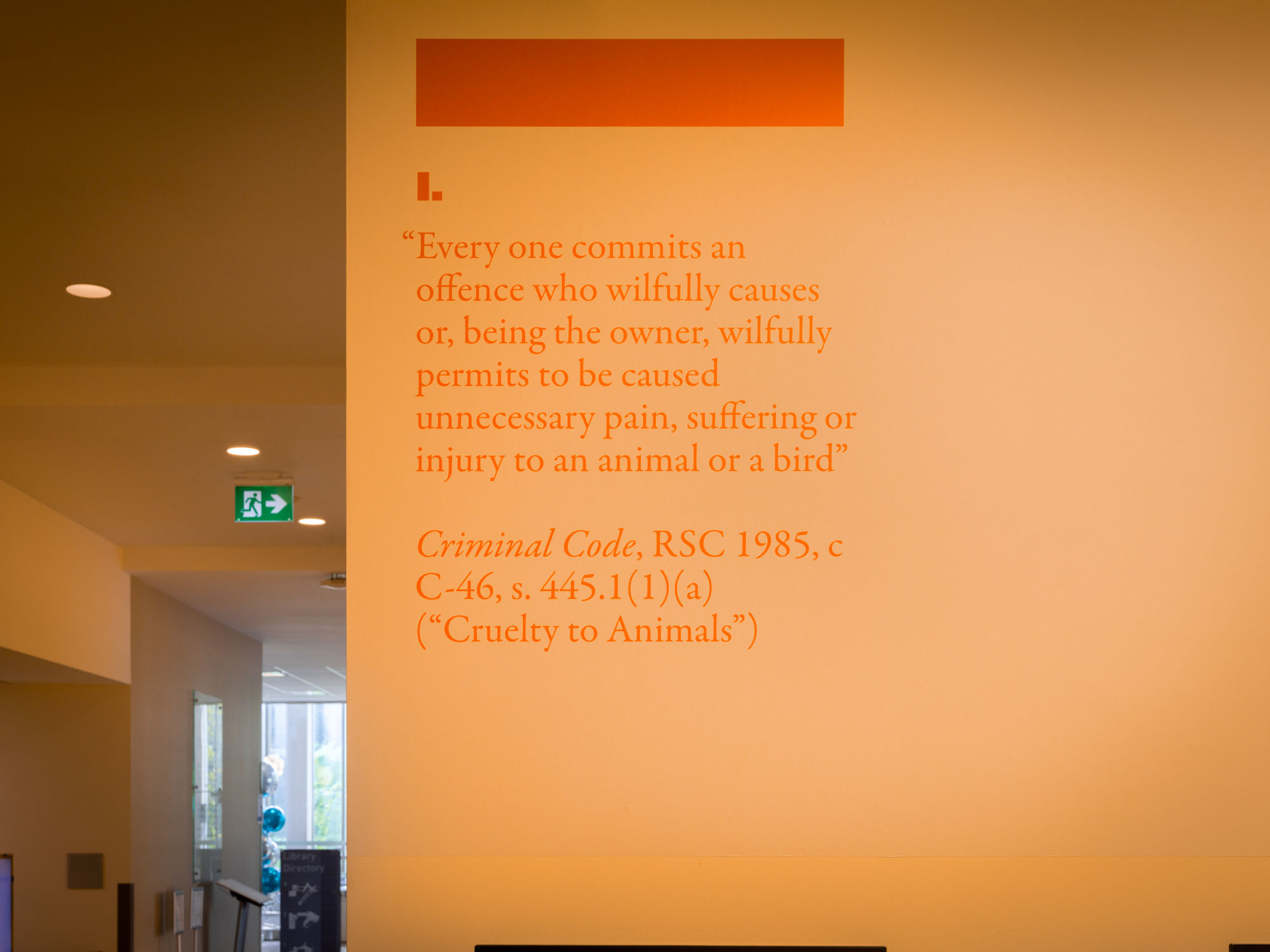
Photo by Darren Rigo

Photo by Darren Rigo

Photo by Darren Rigo
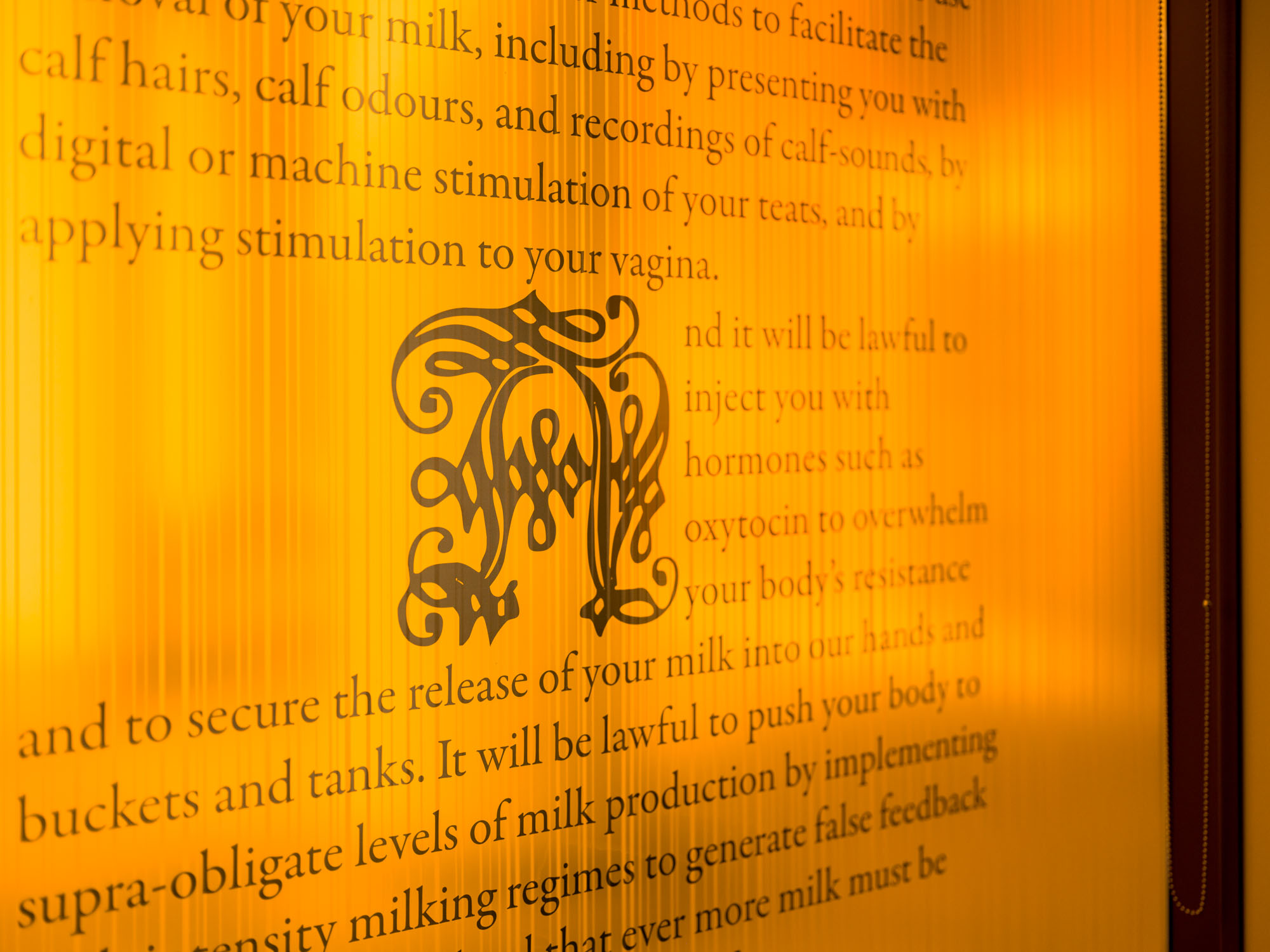
Photo by Darren Rigo

Photo by Darren Rigo
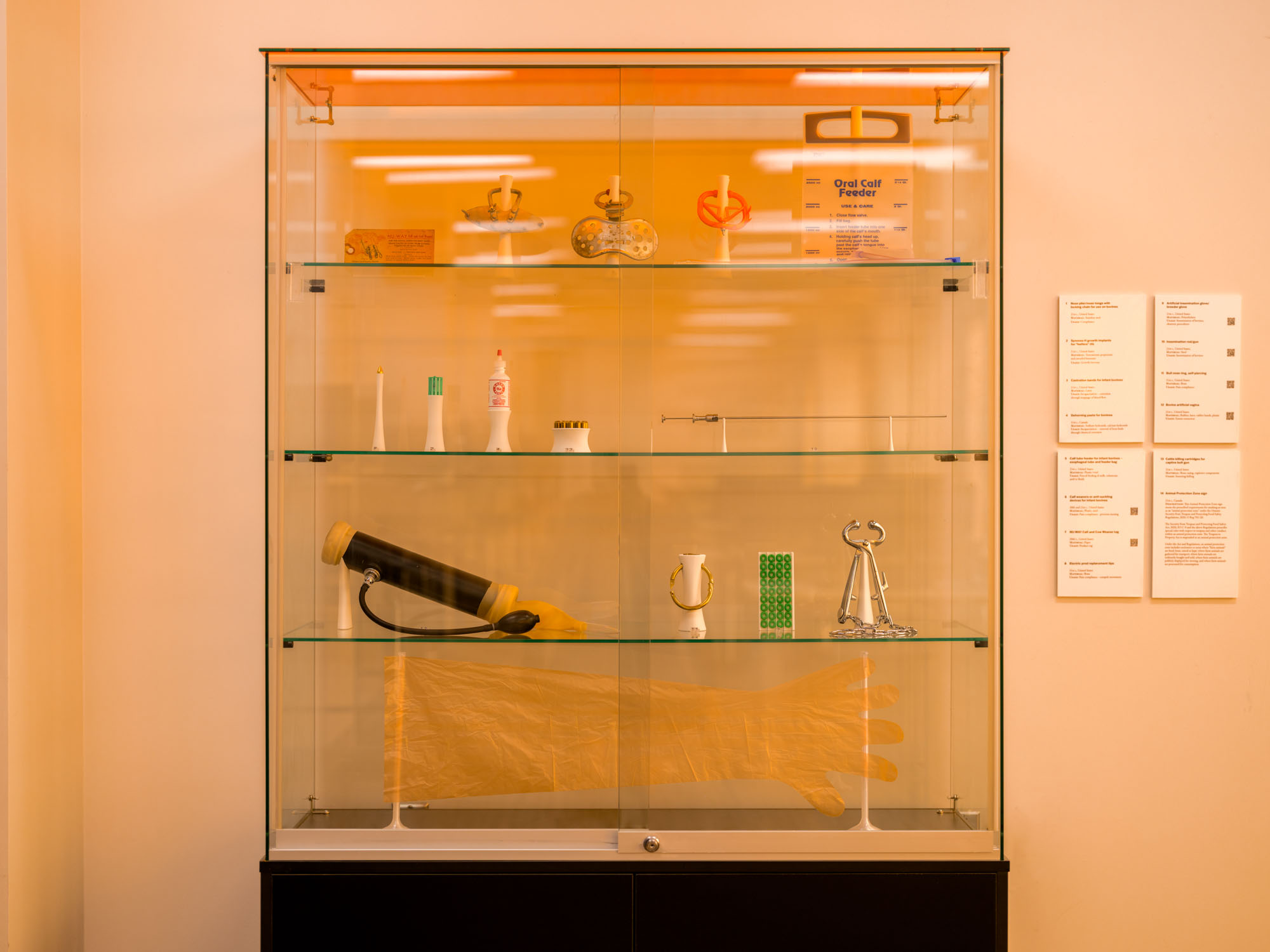
Photo by Darren Rigo

Photo by Darren Rigo

Photo by Darren Rigo

Photo by Darren Rigo

Photo by Darren Rigo
We acknowledge the support of:
The Hadley Family Foundation
The Animal Law Program at the University of Toronto, Faculty of Law
The Bora Laskin Law Library at the University of Toronto, Faculty of Law
The creators of this exhibition are:
M.H. Tse
Rachel Wallace
Anne Campbell
Petrina Ng
Yshia Wallace